BY IBUKUN EMIOLA
Across Oyo State, smallholder women farmers—long recognised as the backbone of rural food production—are waging a quiet but debilitating battle to access and retain farmland.
An investigation by the News Agency of Nigeria (NAN) reveals that yearly, land leasing, prohibitive land prices, cultural barriers, and rising insecurity are undermining women-led agriculture, threatening food production in a state considered one of Nigeria’s major food baskets.
Every planting season, Mrs Oluremi Oyetunji, a smallholder farmer in Apaadi, Oluyole Local Government Area, prays for two things: the rains and leniency from her landlord. Her fear is simple—losing the land before harvest.
“I leased the land I am using for about N20,000 to N30,000; when I tried to buy land, it was about N90,000 back then in 2006.
“Now, it is around N1.2 million near Ayegun, and I just cannot afford that,” she said.
Like hundreds of women farmers interviewed across rural Oyo communities, Oyetunji’s dependence on short-term land leases leaves her unable to plan for the future or expand production.
For Mrs Motunrayo Olusola, a young mother of five who began farming five years ago, the uncertainty has cost her dearly.
“I lost a huge amount of money because the sons of the landowner where I leased land asked me to leave the land untimely.
“I had wanted to sell the maize after it dried to increase the income, but I sold the maize plantation cheaply due to the threat.
“If you want to lease land for two to three years, most landowners will not agree; they only want yearly leasing,” she said.
This restrictive practice, common across Oyo State, limits farming productivity and reinforces poverty among smallholder women who already shoulder the bulk of subsistence food cultivation.
Data from the World Bank shows that only eight per cent of Nigerian women own land in their own names—one of the lowest ownership rates in Sub-Saharan Africa.
Most women access farmland through husbands, family networks or short-term lease agreements.
These fragile arrangements offer neither legal protection nor room for investment in irrigation, mechanisation or soil improvement.
A 2022 study in the African Journal of Land Policy estimated that Nigerian women operate on an average of just 0.43 hectares, usually leased for a single season.
Such insecurity not only stifles productivity but makes them vulnerable to sudden eviction.
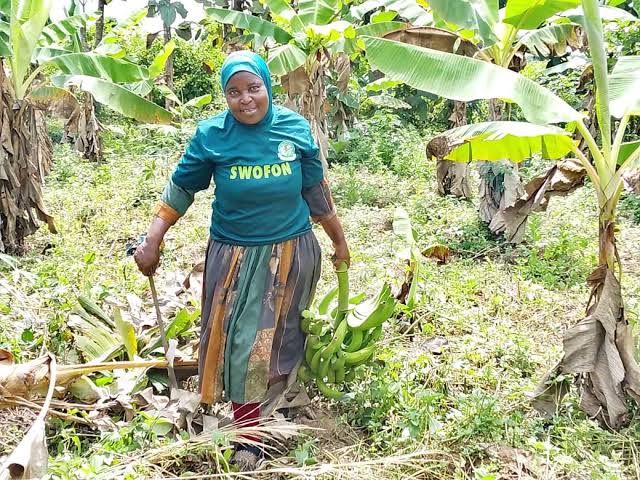
Mrs Rashidat Abass, a member of the Smallholder Women Farmers Organisation of Nigeria (SWOFON), Oluyole LGA, recalls mediating a dispute where women were forced out mid-season.
“We appealed to the landowners to allow the women harvest before leaving.
“The family decided to reallocate the land among themselves even though the women had already cultivated it; we begged for an extension so the crops could mature,” she said.
These stories are common—stretching from Ibadan’s peri-urban villages to Oyo, Iseyin, and Ibarapa.
A dataphyte analysis showing the ratio of land ownership in Nigeria between males and females.
Beyond cost and insecurity, cultural norms remain a major barrier for women.
“The Baales will not answer you if you go alone; they say they do not sell to women.
“If you insist, they inflate the price or sell you land belonging to someone else,” Mrs Zainab Irekeola, a farmer from Idi-Iroko, Akinyele LGA, said.
Irekeola recalled how she once lost a plot because the landowner’s son secretly resold it.
To circumvent these barriers, many women now register farms under company names or bring male relatives for authentication.
Mrs Temilade Olabiyi, SWOFON women leader in Oluyole LGA, made a submission.
“Oftentimes, community leaders or families will only sell to men or companies.
“A woman can easily be defrauded; all the land I use for farming is acquired with my company’s name, with my husband and a lawyer present,” she said.
Her remark reflects findings from a 2024 study in the Journal of Environmental Law & Policy, which noted that women’s access to land in Nigeria often depends on their relationships with husbands or male relatives.
Even when women are willing to buy, soaring land prices put land ownership out of reach.
“An acre in Akinyele now sells for between N2 million and N2.5 million.
“The state farm settlements I asked about were already full,” Irekeola said.
Similarly, Olabiyi said farmland at Latunde village jumped from N300,000 per acre in 2020 to between N800,000 and N1 million in 2025.
A Dataphyte analysis corroborates these reports, showing that peri-urban land values around Ibadan have increased fivefold in the last decade due to housing estates, road expansion, and government acquisitions.

Recommended for you






Leave a Reply
Leave a Reply