BY EBUKA UKOH
A country that cannot protect its foot soldiers does not hold out any promise of safety to ordinary citizens. That is the hard truth Nigeria must confront now.
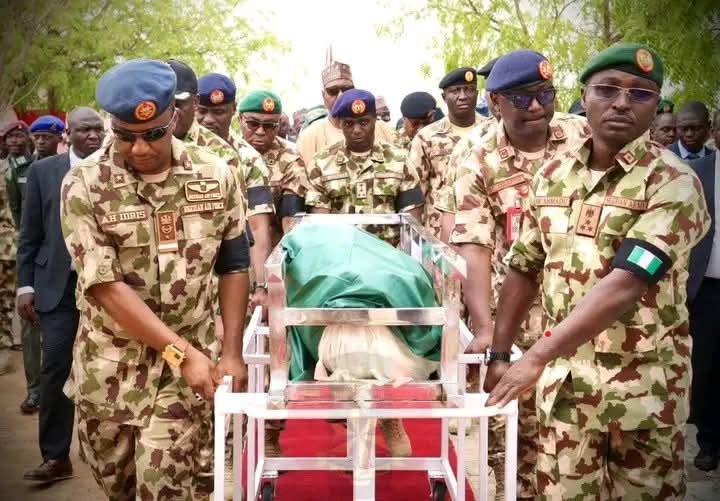
The untimely felling of Oseni Omoh Braimah, commander of the 29 Task Force Brigade, Maiduguri, in a coordinated attack on a military base in Benisheikh in April 2026 is not only a tragedy, but also an alarm. It is a signal that the line between order and breakdown is thinner than we are ready to admit.
When a Brigadier-General falls inside a fortified base, the question is no longer whether Nigeria faces insecurity; it is whether the country can maintain its security. Another question is whether the system built to contain it is holding at all.
When a man dies, it should remind you of your own fragility, your own mortality, and the thin line between life and death. No title, rank or office can erase that fact. The Braimah tragedy was not an isolated failure.
In November 2025, Musa Uba, who was commanding the 25 Task Force Brigade, died at the hands of fighters linked to the Islamic State West Africa Province in Borno State. The militants ambushed, captured, and executed him. Two senior officers…two high-level losses…all within months.
These are not routine battlefield casualties. The men were senior commanders operating within layered security environments, supported by intelligence, personnel, and infrastructure. The deaths point to something deeper than individual vulnerability. They point to systemic strain.
When the shield fails
Military bases are designed as anchors of control. They concentrate force, intelligence, and logistics. They are meant to project strength and reassure surrounding communities that the state is present and capable.
The attack in Benisheikh challenges that assumption.
Reports indicate a coordinated assault that lasted several hours, overwhelming defences and inflicting significant casualties. In such scenarios, response capacity becomes critical. Reinforcement timelines, air support, and communication chains are not abstract concepts; they are essential components of effective military operations. They determine whether a base holds or falls.
When a position of this scale is breached, the question becomes unavoidable. Where was the support in the first place?
Raising this question is not to diminish the courage of those who fought. It is to examine whether the system around them functioned as it should because courage without support becomes sacrifice. And repeated sacrifice without systemic correction becomes recurrent failure.
The implications extend beyond the military. If a hardened installation can be overrun, what confidence can civilians draw about their own safety?
Nigerians as victims
The Nigerian today is not simply struggling; he is exposed, living within layered uncertainty. At the individual level, one is exposed to violence, exposed to uncertainty, exposed to a system that appears increasingly unable to guarantee the most basic function of a state…the protection of life and property.
Communities in conflict-prone regions navigate the constant risk of attack. Urban centres contend with crime and instability. Rural populations face exposure with limited protection.
The effect is cumulative. Each incident adds to a sense that security is not guaranteed, protection is uneven, and response is unpredictable.
Language matters in this context. When perpetrators of violence are described in softened terms, it creates distance between the act and its consequence. For those affected, there is no distance… It is only a loss.
A father does not experience his death as a statistic. A community does not rebuild with numbers. The danger is not only violence itself. It is the normalisation of that violence. When deaths are reported, absorbed, and quickly replaced by the next headline, a threshold begins to shift. What once shocked begins to feel expected. And expectation reduces urgency.
Trust under pressure
Security is not sustained by force alone. It depends on trust…Trust that institutions are functioning, trust that threats are understood, trust that responses will come when needed. In Nigeria, that trust has been strained by persistent concerns.
Voices such as Commodore Kunle Olawunmi, in past interviews, have raised suspicions about possible internal compromise, the state’s knowledge of sponsors of insurgency, and the presence of insider collaboration. Former President Goodluck Jonathan also warned during his tenure that elements within government and its security architecture had been infiltrated.
These are serious pointers worthy of formal investigations; their continued circulation in the public space reflects a broader issue of a deficit of confidence.
When citizens begin to question whether the system is fully aligned with their protection, uncertainty deepens, and uncertainty weakens cooperation, intelligence sharing, and collective resilience. A security architecture under pressure cannot afford a crisis of trust.
Weight of unequal justice
The sense of vulnerability is not confined to the battlefield; it is reinforced when court verdicts appear disconnected from lived reality.
The case of Sunday Jackson, a Nigerian, illustrates this tension. A farmer was attacked and injured on his farmland; he defended himself and was subsequently sentenced to death, with courts holding that he should have fled rather than used lethal force.
In legal reasoning, such outcomes are grounded in the interpretation of self-defence standards. But public perception does not engage in technicalities. Rather, it engages with the outcome.
What is seen is a man who survived an attack being punished for it.
At the same time, high-profile political disputes often move through the system at different speeds and with different levels of flexibility. This contrast, whether fully accurate or not, shapes how citizens understand justice.
And when justice appears uneven-handed, its authority weakens. A system cannot ask for trust while presenting outcomes that seem to fluctuate with context or status.
Dangerous threshold
What occurs when citizens start to question the state’s ability to safeguard them?
This is not a question that lends itself to easy answers. It carries risk. It touches on the boundaries between order and disorder.
But ignoring it does not make it disappear.
When insecurity persists, when response appears delayed, and when institutions struggle to inspire confidence, the gap between expectation and reality widens.
Within that gap, frustration grows.
It is essential to be clear. The answer to state weakness cannot be lawlessness. A breakdown of order would compound the crisis, not resolve it. But acknowledging the question is necessary. Because it signals a threshold that must not be crossed.
Thought Before Action
Nigeria stands at a juncture requiring clarity. Not only clarity about the nature of the threat, but also about the performance of the systems designed to address it.
Reform is not a mere slogan. It is an intentional process. It requires an honest assessment of operational gaps. It requires accountability where failures occur. It requires investment not only in equipment, but also in coordination, intelligence, and institutional integrity.
It also requires communication that reflects reality. Citizens do not expect perfection. They expect seriousness.
Kwame Nkrumah once observed that revolutions are shaped by those who combine thought and action. The relevance of that idea today lies not in upheaval, but also in discipline.
Nigeria does not need a reaction without direction. It needs leadership that thinks clearly and acts decisively. Nations do not collapse only when they are attacked. They also collapse when failure becomes familiar, outrage fades faster than the violence that provoked it, and those sworn to protect are left to fall without consequence.
Nigeria cannot afford that descent, because if a Brigadier-General can be killed in a place designed to be secure, then the illusion of safety has already eroded or broken outright. And once a country loses its ability to protect its own, what remains is not order, but a quiet, dangerous acceptance that anyone can be next.
May Brig-Gen Braimah’s memory turns out to be a blessing to his compatriots, country, and continent.
Mr Ukoh, writing from New York, United States, is an alumnus of the American University of Nigeria, Yola, a PhD student at Columbia University, New York, and a coauthor of Built By The Ancestors

Recommended for you




Leave a Reply
Leave a Reply