Entertainment
Simbiat Asiru Repositions Fashion Business as TÀBÍRA Studio

By Nonye Moses
After more than a decade in fashion entrepreneurship, Nigerian designer Simbiat Asiru is charting a new course for her business with TÀBÍRA Studio, a contemporary ready-to-wear womenswear label that emerged from the rebranding of Simbby House of Fab in 2025.
Founded in 2011, Simbby House of Fab marked Asiru’s entry into the fashion business, offering bespoke and ready-to-wear clothing. More than a decade later, the transition to TÀBÍRA Studio reflects an effort to build on that experience while establishing a clearer brand identity and direction for the business.
For Asiru, the journey has involved more than designing clothes. It has required developing technical skills, understanding customers, exploring creative expression and navigating the demands of entrepreneurship.
Her professional training began at Zaris Fashion Academy in Lagos, where she studied between 2010 and 2011. She subsequently established Simbby House of Fab, taking on responsibilities that ranged from developing design concepts and drafting patterns to constructing garments and translating clients’ preferences into finished pieces.
The experience provided a practical foundation in the fashion industry, where creative ability must be matched by the discipline required to run a business.
From Simbby House of Fab to TÀBÍRA Studio
After years of operating under the Simbby House of Fab name, Asiru rebranded the business as TÀBÍRA Studio in 2025. The move marked a new phase in the development of the label, bringing its identity and creative direction into sharper focus.
The rebrand also raises an important question for entrepreneurs in the creative industries: how does a business evolve without losing the experience and identity that shaped its beginnings?
For Asiru, the transition builds on the practical knowledge acquired through years of designing and producing garments, while providing an opportunity to approach the business with renewed direction.
“Simbby House of Fab was where I built my foundation and learned the realities of the fashion business. TÀBÍRA Studio represents the direction I want to take that experience. It is about building on what I have learned while being more deliberate about the identity of the brand and what I want it to become.”
Her academic development has also contributed to her broader professional experience. In 2024, Asiru completed a Master of Science in Project Management at the University of Northampton, adding formal training in planning, organisation and project delivery to her years of practical experience in fashion.
The combination is relevant to an industry in which designers must manage creative development alongside production schedules, resources, customer expectations and business planning.
For a fashion label seeking to establish itself in the ready-to-wear market, these operational considerations can be as important as the designs themselves. A recognisable brand identity may attract attention, but consistency in production, customer experience and business management is essential to sustaining that interest.
Defining a distinct design identity
TÀBÍRA Studio’s aesthetic centres on expressive silhouettes, confident colours, distinctive prints and considered details. Its collections combine statement-making designs with wearability, drawing on texture, movement and contemporary approaches to textile expression.
Some designs incorporate textiles and visual references associated with Nigerian fashion traditions, interpreted within a contemporary womenswear wardrobe.
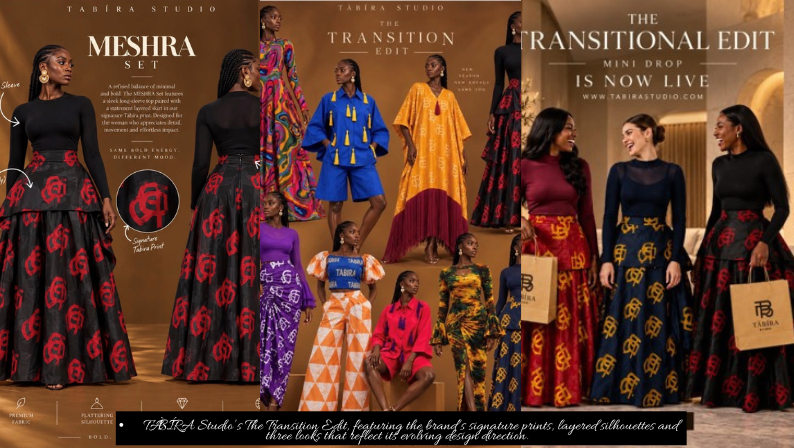

The brand’s message, “Bold. Timeless. Tabira,” reflects its emphasis on individuality and self-expression. Rather than treating clothing solely as a practical necessity, the label presents womenswear as a means through which women can communicate their personalities while maintaining a polished appearance.
“I want the woman who wears TÀBÍRA to feel confident in what she is wearing. For me, it is important that a design has character and makes a statement, but that it also feels wearable. I want women to express themselves through our pieces without feeling that they have to compromise on practicality.”
This design philosophy places the brand at the intersection of visual expression and everyday dressing. Its commercial success, however, will depend on how effectively the label translates that vision into collections that appeal to its intended customers.
Fashion entrepreneurs must continually make decisions about fabric selection, production costs, pricing, product availability and marketing. These choices influence not only the finished garment but also the kind of customer a brand can reach and the pace at which it can grow.
Asiru’s experience across fashion design, styling, fashion writing and creative direction gives her exposure to different aspects of the creative process, from garment construction to the visual presentation of a brand.
Taking TÀBÍRA Studio to the runway
In 2026, TÀBÍRA Studio presented ATUNBÍ II: The Rebirth Edit at Culture Fashion Show UK, giving the label an opportunity to showcase its designs in a runway setting.
The presentation formed part of a fashion platform celebrating culture, creativity and emerging talent under the creative direction of Gemma Hall.
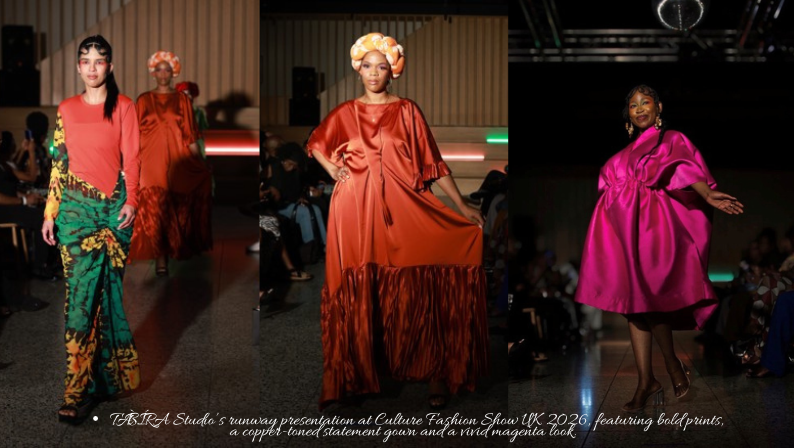
The collection featured vivid printed ensembles, sculptural silhouettes, fluid fabrics and bold colour combinations, highlighting the range of visual elements that inform the label’s design direction.
Runway presentations provide designers with an opportunity to communicate a collection beyond individual product images. Through styling, movement and the sequencing of looks, a designer can present a more cohesive interpretation of a brand’s aesthetic.
For an emerging label, participation in such events can also contribute to visibility, industry networking and the development of marketing material. Nevertheless, the long-term value of runway exposure depends on how effectively it supports customer acquisition, commercial opportunities and continued brand development.
“Presenting ATUNBÍ II: The Rebirth Edit was an opportunity to bring the TÀBÍRA Studio vision to life in a different setting. Seeing the designs presented as a collection allowed the brand’s colours, silhouettes and overall aesthetic to come together in a way that communicates more than individual pieces can on their own.”
The showcase represents a milestone in the label’s development as it seeks to build recognition for its designs and connect with audiences beyond its existing market.
The business behind the creativity
The evolution from Simbby House of Fab to TÀBÍRA Studio illustrates a central reality of fashion entrepreneurship: building a brand requires continuous decisions about what to retain, what to change and where to direct limited resources.
Creative vision may establish a label’s identity, but its long-term prospects also depend on operational discipline, customer relationships and the ability to respond to changing market conditions.
Asiru’s project management education provides an additional framework for approaching planning and coordination, while her experience in garment production offers practical insight into the process of taking a design from concept to completion.
“One of the things entrepreneurship teaches you is that loving what you do is only part of the journey. You also have to be willing to learn, make difficult decisions and think about how to build something that can stand the test of time. Creativity gives you the vision, but you need structure and consistency to move that vision forward.”
This distinction is important in the fashion industry, where a visually distinctive collection does not automatically translate into a sustainable business. Entrepreneurs must consider how their products are priced, how production is organised and how their brands remain relevant to customers.
For TÀBÍRA Studio, the challenge is to translate its design identity into a commercially sustainable operation while continuing to develop its collections and market presence.
The rebrand provides a platform for that effort, drawing on the foundation established by Simbby House of Fab while presenting the business under a new identity.
Building for the next chapter
As TÀBÍRA Studio moves forward, its development will depend on its ability to maintain a recognisable design language, reach its intended customers and build the operational foundations required for growth.
Collaborations and fashion showcases may support brand awareness, while the consistency of its collections and the strength of its customer relationships will be important to its longer-term prospects.
“My vision is to continue developing TÀBÍRA into a brand that women recognise for its identity, quality and design approach. I want us to keep growing creatively while building the business in a way that allows it to remain consistent and sustainable.”
From its beginnings as Simbby House of Fab in 2011 to its rebranding as TÀBÍRA Studio in 2025, Asiru’s entrepreneurial journey reflects the evolution of a fashion business shaped by experience, creative development and a renewed sense of direction.
The next chapter will be measured not only by the collections the label presents, but also by its ability to turn its creative identity into a sustainable business with a growing customer base.
About Simbiat Asiru and TÀBÍRA Studio
Simbiat Asiru is a fashion designer, stylist and creative director. She founded Simbby House of Fab in 2011 and rebranded the business as TÀBÍRA Studio in 2025. TÀBÍRA Studio is a contemporary ready-to-wear womenswear label.
Website: https://www.tabirastudio.com/
Instagram: https://www.instagram.com/tabirastudio/
Founder’s fashion platform: https://www.instagram.com/simbbyfabgirl/
Fashion blog: https://simbby.wordpress.com/
Runway image credits
Designer: @tabirastudio
Runway production: Culture Fashion Show UK (CFSUK)
Creative direction: Gemma Hall, Founder and Creative Strategy Director
Photography: Green Vision Photography