BY BONNY AMADI
The spate of hardship in Nigeria has become increasingly unbearable with unimaginable devastating consequences.
As a result, the Nigeria Labour Congress (NLC) has painted a grim picture of the state of the nation and its workers, warning that rising insecurity, deepening poverty, and worsening economic conditions are pushing citizens to the brink.
The NLC and other stakeholders in the Nigerian project had consistently blamed hardship in the country on the manner fuel subsidy was removed by the present government.
However, Minister of Finance and Coordinating Minister of Economy, Taiwo Oyedele, has insisted that the presidency will not bring back fuel subsidy, despite widespread clamour over the effect of its removal on the cost of living.
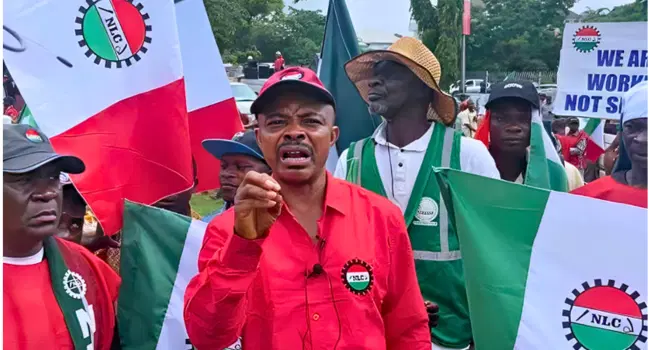
NLC President, Joe Ajaero, was reported to have disclosed in an interview, that the situation has reached a critical point where survival, rather than productivity, has become the priority for many Nigerians, especially workers.
According to him, there is now a broad consensus across the country, including among government officials, that insecurity has severely undermined livelihoods, disrupted economic activities and heightened hardship.
He stressed that workers can no longer operate effectively in an atmosphere of fear, displacement, and uncertainty, with many forced to abandon their homes and means of livelihood.
Ajaero said: “Everyone in this country will tell you that insecurity has finished the country. It’s not a question of whether I am in government or not. Even people in government are lamenting. It is a problem for all of us. Workers cannot operate in those areas, and that is very important.
“The psychological fear of moving from one place to another is increasing, and that cannot even be quantified. People are moving from their communities to Internally Displaced Persons, IDP, camps. Insecurity has really dealt with us.”
Linking insecurity to poverty, the NLC president noted that the crisis had gone beyond the question of decent work to the availability of jobs altogether.
“When you now talk of challenges, is it decent work or even work at all? Insecurity has affected employment in the country. Apart from lives lost, people can’t invest. Even Nigerians abroad will tell you insecurity is too much for them to return.
“People are running to areas they think will give them protection. Therefore, jobs are suffering and poverty is increasing. The majority of Nigerian workers, especially in rural communities, depend on their farms. If they can’t go to farm, their livelihoods col- lapse,’’ Ajaero said.
On the economic front, he criticised the disconnect between macro-economic indicators and the lived reality of citizens.
He argued that “If you say the economy has grown and I can’t move from where I am because transportation is high, how has that translated to my life? We are not seeing it.”
The NLC President also pointed to the impact of global events on local hardship, saying “the moment there was tension between Iran and America, fuel prices jumped to about N1,300– N1,400.
‘’That shows we are not insulated. But when crude prices go up and government earns more, how has that benefited the worker?”
Ajaero queried why in- creased government revenue had not translated into improved wages.
“Did you add N50,000 or N100,000 to workers’ earnings to cushion the effect? The worker is buying fuel at N1,400, while salary remains the same. Government is benefiting, but the worker is running at a deficit,’’ he said.
Growing burden on workers
The labour leader, who lamented the growing burden on workers amid rising taxation, said: “The level of taxation now is a problem. You have formal and informal taxes. Okada riders, market women, before they even start work, are paying levies. Nigerians are groaning.”
On alternatives to rising fuel costs, he expressed disappointment that “we thought Compressed Natural Gas, CNG, will stabilise transportation, but where are the stations? ‘How many people have converted? The same applies to electric vehicles— there is no infrastructure. So, people have no alternatives.”
Addressing human rights concerns, Ajaero argued that economic hardship itself constituted a major violation.
“Which human rights are worse than starvation? When you don’t pay people adequately, their fundamental rights are already compromised,’’ he added.
Ajaero also raised concerns about labour conditions in parts of the private sector, adding that “some employers subject workers to very harsh conditions

Recommended for you




Leave a Reply
Leave a Reply