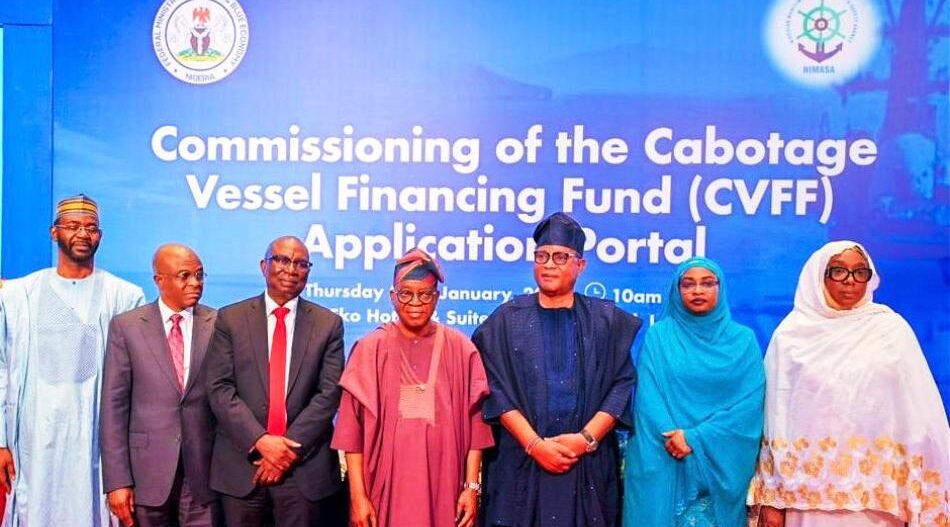
Nigeria’s Minister of Marine and Blue Economy, Dr Adegboyega Oyetola, on Thursday 22 January 2026 officially launched and unveiled the Cabotage Vessel Financing Fund (CVFF) Application Portal, marking a historic step in Nigeria’s long-awaited journey to operationalise structured financing for indigenous ship ownership. The event, held at Eko Hotel and Suites in Victo- ria Island, Lagos, drew senior government officials, maritime industry leaders, legislators and key stakeholders from across the sector.
Declaring the portal open, Dr Oyetola described the occasion as “a deliberate and strategic step in repositioning Nigeria’s maritime sector as a central pillar of national development.” He noted that the launch aligned with the broader national objective of diversifying the economy and unlocking the vast potential of Nigeria’s maritime domain, coastal resources and inland waterways.
“The maritime sector remains the backbone of global commerce, yet despite Nigeria’s strategic geographic location and vibrant entrepreneurial base, our participation in coastal and inland trade has remained limited,” the Minister said. “A major constraint has been the absence of a functional, credible, and transparent financing framework to support indigenous ship ownership. Today, we are changing that narrative.”
Dr Oyetola recalled that the Cabotage Vessel Financing Fund, established under the Coastal and Inland Shipping (Cabotage) Act of 2003, was designed to address the financing gap faced by Nigerian shipowners. However, he acknowledged that institutional and structural considerations over the years delayed its operationalisation. He stated that upon assuming office, his Ministry adopted a clear policy objective to strengthen Nigeria’s maritime capacity and ensure that the CVFF is implemented strictly in line with sound governance and financial principles.
“The CVFF is structured as a strategic development instrument,” he said. “By facilitating access to competitive vessel financing for indigenous operators, we hope to reduce reliance on foreign-flagged vessels in our coastal trade, improve retention of value within the domestic economy, create employment opportunities for Nigerian seafarers, and stimulate growth in allied sectors such as shipbuilding, ship repair, and maritime services.”
He further emphasised that the Fund’s impact extends beyond economics, noting that a stronger indigenous fleet would enhance maritime safety and security while supporting national efforts to maintain a regulated and efficient maritime domain. Stressing accountability, he reminded potential beneficiaries that the CVFF is a revolving fund that must be prudently utilised and repaid to ensure sustainability for future generations of maritime entrepreneurs.
The Minister explained that the newly launched digital portal would serve as the institutional gateway for transparent administration of the Fund. “Through this platform, eligible Nigerian shipowners can submit applications that will be assessed against clearly defined criteria, sup- ported by robust due diligence and professional financial oversight through approved Primary Lending Institutions,” he said. He added that the portal aligns with the Federal Government’s e-Government agenda and efforts to reduce bureaucratic bottlenecks and improve ease of doing business.

Leave a Reply
Leave a Reply