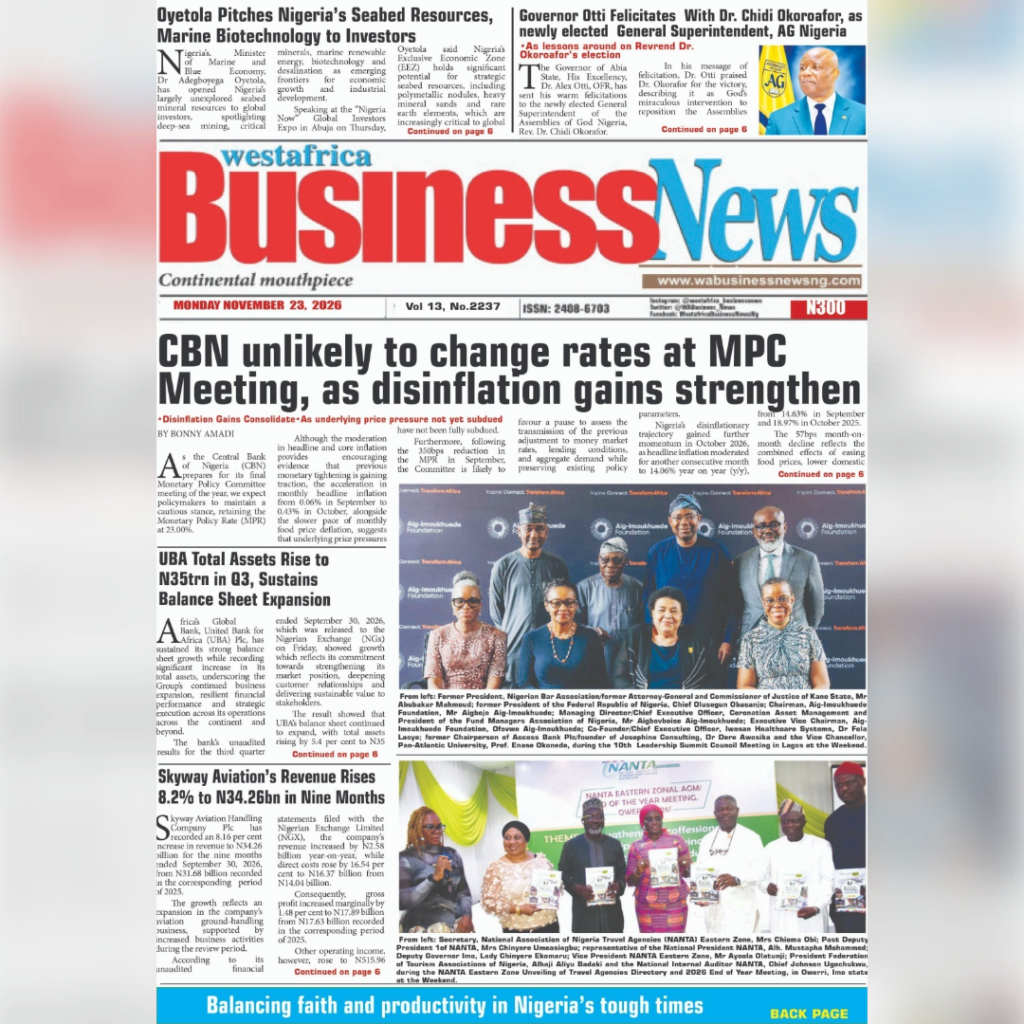
- Disinflation Gains Consolidate
- As underlying price pressure not yet subdued
BY BONNY AMADI
As the Central Bank of Nigeria (CBN) prepares for its final Monetary Policy Committee meeting of the year, we expect policymakers to maintain a cautious stance, retaining the Monetary Policy Rate (MPR) at 23.00%.
Although the moderation in headline and core inflation provides encouraging evidence that previous monetary tightening is gaining traction, the acceleration in monthly headline inflation from 0.06% in September to 0.43% in October, alongside the slower pace of monthly food price deflation, suggests that underlying price pressures have not been fully subdued.
Furthermore, following the 350bps reduction in the MPR in September, the Committee is likely to favour a pause to assess the transmission of the previous adjustment to money market rates, lending conditions, and aggregate demand while preserving existing policy parameters.
Nigeria’s disinflationary trajectory gained further momentum in October 2026, as headline inflation moderated for another consecutive month to 14.06% year on year (y/y), from 14.63% in September and 18.97% in October 2025.
The 57bps month-on-month decline reflects the combined effects of easing food prices, lower domestic energy costs, relative exchange rate stability, and the lagged impact of previous monetary tightening.
While the sustained moderation signals an improving price environment, the persistence of elevated food costs and uneven price movements across consumer categories suggests that inflationary pressures remain a concern.
An examination of the divisional contributions shows that food and non-alcoholic beverages remained the largest contributor to headline inflation at 5.63 percentage points, representing approximately 40.0% of the overall rate.
Restaurants and Accommodation Services followed with 1.82 percentage points, while Transport and Housing, water, electricity, gas, and other fuels contributed 1.50 and 1.18 percentage points, respectively.
On a monthly basis, food accounted for 0.17 percentage points of headline inflation, while Restaurants and Accommodation Services and Transport contributed 0.06 and 0.05 percentage points, respectively.
This underscores the continued influence of essential consumption categories on household expenditure and the overall inflation trajectory.
Food inflation moderated to 19.13% y/y in October from 19.59% in September, representing a 46bps decline. On a m/m basis, food prices declined by 0.75%, although at a slower pace than the 1.55% contraction recorded in September.
The improvement reflects lower prices of selected food items, including locally produced rice, vegetable oil, frozen fish, fresh catfish, beef tripe, and millet flour, among others, suggesting that increased market availability during the peak harvest season is gradually filtering through to consumer prices.
Nevertheless, elevated food inflation continues to constrain household purchasing power, particularly among low-income earners, while insecurity, transportation bottlenecks, and distribution inefficiencies remain significant risks to sustained food price moderation
Beyond food, core inflation declined significantly to 10.78% y/y from 12.95% in September, representing a 217bps reduction. On a m/m basis, core inflation fell to -0.53% from 1.11%, indicating a broader moderation in underlying price pressures. Similarly, goods inflation declined to -0.01% from 0.10%, while services inflation fell to -0.94% from 0.41%. Imported food inflation also moderated to -0.38% from 0.04%.

Recommended for you






Leave a Reply
Leave a Reply